I’ve come to the conclusion that whiteness is something like a drug. It’s “that boy.” It’s “that girl.” It’s “that white stuff.” It’s every other euphemism that I could list all day long, and it was a recent conversation with a white liberal that made me come to this comparison.
A friend of mine asked to interview me on camera for her documentary about attempted racial cleansings in southern Missouri.
Listen to descendants of survivors of the 1917 East St. Louis Race Massacre.
We had a lovely wide-ranging conversation and as I was leaving, I crossed paths with someone waiting to be interviewed next. He was a professor of History. And because conversations with smart people are some of my favorite conversations, instead of getting in my car and going home, I decided to sit and talk with him while he waited for his turn on camera. As we shared our biographies, and made sure we each had similar political leanings, the conversation turned to the current political state of the U.S.
Now, mind you he teaches Mexican-American history and African-American history. The bulk of our conversation focused on the terrible irony of most of his Mexican American students voting for Donald Trump. I wasn’t shocked by this information. Just like the Cubans in Miami, I am aware of how a combination of patriarchy, anti blackness, (outward and internalized), along with the U.S.’s successful propaganda that places itself as “liberator” despite being the wizard behind a very thin colonialist curtain, has resulted in a lot of immigrant populations being solidly right wing. I was bothered by the fact that he had taught students in this community for many years, and felt resigned to the fact that he could have no impact on their politicization or on the radicalization of their political critique. He lacked revolutionary optimism. However, that wasn’t what bothered me most.
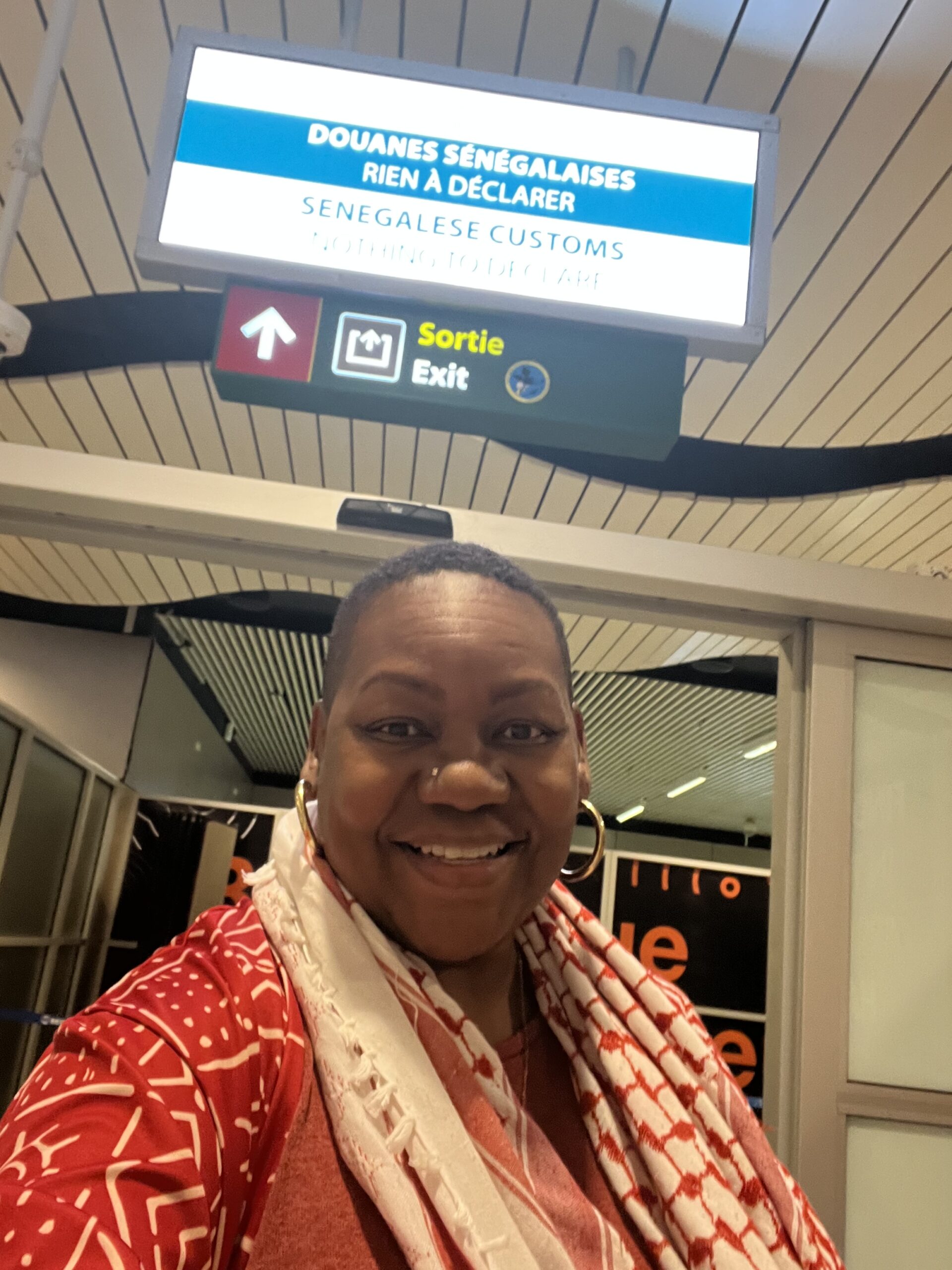
I recently traveled to Senegal to present at the Afrofuturism 2.0 conference. Watch the vlog!
Our conversation meandered into what may have led to a fascist’s rise to power in the U.S. I said, “I thought I was too cynical to be shocked. But every news cycle I’m disabused of that belief!” He responded by naming cynicism as a prime cause of Trump’s ascendancy. He shared how he would hear his grade school teachers say, “America is the greatest country in the world,” and think that it was a corny or even pompous thing to say. But, he believed, that what we may see through the backwards view of history as trite or arrogant, was actually more valuable than we realized. He explained that the 1990s represented a turn toward a caustic “cynicism.” “I never hear Trump say anything nice,” he said. “I never hear him say anything good about America.”
I understood him to be positing that liberals and progressives had stopped believing in and extolling the virtues of the American project, (which he believed was good) and like a man who neglects a “good woman,” a slick talking rival (the right wing) had slid in and turned America’s head.
“Are you on dope or dog food?” is what I wanted to ask him. I couldn’t believe that someone who had been immersed in U.S. history, and in particular the history of indigenous erasure (Mexican-American history), and enslavement (African-American history), believed the American project was good, first of all.
Did he believe that the time immediately preceding the 1990s – the Reagan presidency– was “better?” The era where the federal reserve was used to attack working people and destroy unions? Or the decade before that, the beginning of which, women still needed a male co-signer for loans and credit? Or the decade before that, the beginning of which, still saw an American south with “Whites Only” signs?
Further, I couldn’t believe that even if we did give a “millennial cynicism” some of the onus for ICE in the streets kidnapping folks like modern day slave catchers, the destruction of the climate through pollution and a refusal to divest from fossil fuels, and a wealth gap that mimics monarchy and serfdom, that insatiable capitalism wasn’t further up on the list.
Once again a liberal was refusing to name the systemic nature of what we are facing. Boiling this ongoing hellscape down to individual acts. Individual refusal to “appreciate” America.
What it showed me was that he was one of the reasons we are where we are in this moment. And up until recently I could count myself among his number.
Though I can’t say I’ve ever been particularly patriotic, I did believe that the U.S. was recuperable through electoral politics. I didn’t have a truly radical imagination for a future free from capitalist exploitation. I was definitely a “you have to be inside the system to change it,” woman. But I am also black. Which means my ancestors were trafficked here and I’ve never had the luxury of being included in the American story in an uncomplicated way.
So I imagine, for someone white, even with what appears to me to be a much deeper knowledge concerning our political reality; for him, it would be easier to continue to ignore that we have been in an unsustainable cycle that has reached its logical conclusion.
I imagine if I were a white cisgendered man, (as the history professor appeared to be), a man at the top of the income hierarchy and the lifespan hierarchy. A man whom every president has looked like except for one, I too would be resistant to suggestions from me about ways to structure essay questions that prick the radical imagination of his students.
He didn’t want to have that conversation anyway. He just wanted America to realize how good he had it and come back.
He just wants Trump to stop fucking up his high.
In Talking Back: Thinking Feminist, Thinking Black, bell hooks writes, “Liberalism is rooted in the notion of a benevolent elite who will ‘allow’ others to share in the existing structure of power, rather than the idea that we must radically reconstruct society.”
There is no gradual reform plan that can save us. The solution for our problems is not just an election away. We must all get off the “stuff” – the whiteness and the neoliberalism that causes us to work toward an unachievable America that never existed.